Category: Casino

  • How Old to Enter a Casino? A Global Age Guide

    How Old to Enter a Casino? A Global Age Guide

    The answer to “how old do you have to be to go to a casino” sounds like it should be one number. It is not. It depends on where you are, sometimes down to the state or province, and even on which type of gambling you want to try.

    In most of the world the line sits at 18 or 21. But there are exceptions in both directions, and the rules for a physical casino, an online casino, and a lottery ticket can all differ within the same country. This guide lays out the minimum gambling age by region so you know before you go.

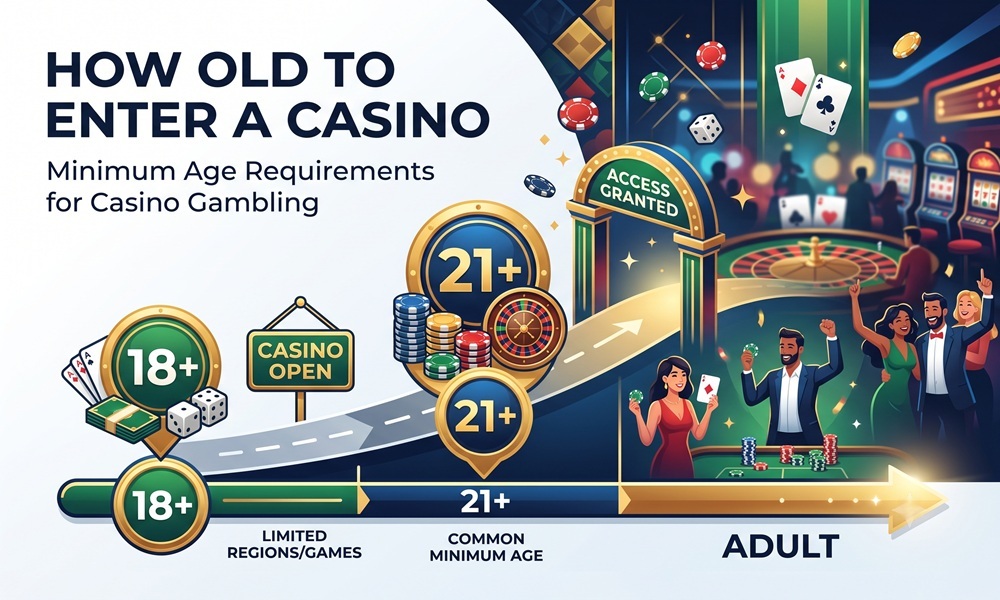
    Quick answer: In most countries the legal casino age is either 18 or 21. It is 18 across the UK, Australia, and most of Europe. In the United States it is usually 21, though some states and tribal casinos allow 18. Canada sets 18 or 19 by province. A handful of places go higher, and some ban gambling entirely. Online casinos verify your age before you can deposit or play. Always check the local rule for your specific location and game.

    Why does the legal casino age vary so much?

    A few factors drive the differences from place to place:

    • The type of gambling. Lotteries and bingo often allow 18, while casinos and some betting require 21.
    • Land-based vs online. Physical and online venues can carry different minimums, and online often skews higher or is verified more strictly.
    • Local law and culture. Religion, regional rules, and each government’s stance on gambling all shape the number.
    • Resident vs tourist. A few countries set one age for citizens and another for visitors.

    With that context, here is the picture region by region.

    What is the legal casino age in the United States?

    The US is the most fragmented case. The gambling age depends on your state and the form of gambling.

    • Casinos: most states set 21. Some, including a small group of states, allow 18.
    • Tribal casinos: often 18, though this varies by nation and state.
    • Lottery and bingo: commonly 18 in most states.
    • Sports betting: mostly 21, with a handful of states permitting 18.

    Reporting on the split suggests roughly 35 states use 21 as the standard casino age, while around 22 states allow some form of gambling at 18. Several states also restrict or ban certain gambling types entirely. Because the rules layer state law over gambling type, the safest move is to confirm the specific requirement for the venue and game you plan to play.

    What is the legal casino age in the UK?

    The UK is refreshingly simple. The minimum age for all forms of gambling (casinos, online betting, slots, bingo) is 18. It applies uniformly across England, Scotland, Wales, and Northern Ireland.

    What is the legal gambling age in Canada?

    Canada sets its age by province, not nationally. The split is straightforward:

    Province group Minimum age
    Most provinces (Ontario, British Columbia, Alberta, and others) 19
    Quebec, Manitoba, and Alberta* 18

    Online gambling follows the same provincial thresholds. (*Provincial rules can shift, so confirm your province’s current requirement before playing.)

    What is the legal casino age across Europe?

    Europe is largely an 18-and-over zone, the de facto standard across most of the continent. Countries including the UK, France, Germany, Italy, Spain, Ireland, and Croatia generally use 18.

    There are notable exceptions where the age is higher:

    Country Minimum age
    Most of Europe (UK, France, Germany, Italy, Spain, etc.) 18
    Belgium, Estonia, Greece 21 (varies by source and activity)
    Portugal 25 for citizens, 18 for tourists

    A wrinkle worth knowing: some countries set different ages for online versus land-based play. Germany, for example, is commonly cited as 18 for online casinos but higher for physical establishments in some cases. And a few European nations restrict or ban gambling outright, so a casino may not exist there at all. When traveling, check the local rule rather than assuming the regional standard.

    What is the legal casino age in Asia and beyond?

    Asia’s landscape is a study in contrasts, and many countries maintain partial or full gambling bans. Where gambling is permitted:

    Region / country Minimum age
    Macau (the world’s gambling capital) 21
    Japan (integrated resorts) 20
    Much of Southeast Asia (where legal) 21
    Australia 18
    Latin America (Brazil, Argentina, Colombia, Mexico) 18
    Nigeria and many African nations 18

    Because rules across Asia in particular vary so widely and change over time, verifying local law before you place a bet is essential.

    How do online casinos check your age?

    You cannot simply tick a box. Licensed online casinos verify your age before allowing deposits or play, using identity verification and age-checking databases. This is part of the “know your customer” (KYC) process.

    Misrepresenting your age online is a serious matter. It can lead to account closure, forfeiture of any funds, and potential legal consequences. Regulators require operators to prevent underage access as a condition of their license, so these checks are not optional for a legitimate site.

    What ID do you need to enter a casino?

    At a physical casino, bring valid government-issued photo ID. A passport, driver’s license, or national ID card is standard. Staff can and do ask, especially if you look close to the minimum age.

    Online, expect to upload ID documents during verification, often before your first withdrawal. Having them ready avoids delays when you want to cash out.

    What happens if you break the age rule?

    Age restrictions exist to comply with the law, protect minors, and reduce problem gambling among young people. They are enforced, and the consequences are real.

    Breaking them can mean removal from the casino, forfeiture of any winnings, account closure online, and in some cases legal penalties. No win is worth those outcomes, and reputable operators take enforcement seriously.

    A quick reference table

    For fast lookup, here is the common minimum casino age by major region.

    Region Typical minimum casino age
    United States 21 (some states and tribal casinos 18)
    United Kingdom 18
    Canada 18 or 19 by province
    Most of Europe 18
    Belgium / Estonia / Greece 21
    Portugal 25 residents, 18 tourists
    Australia 18
    Macau 21
    Japan 20
    Latin America 18

    Treat this as a starting point, not the final word. Ages can change, and local exceptions exist, so always confirm the current rule for your exact location and the specific game you want to play.

    One last point: age is the floor, not the goal

    Meeting the legal age only means you are allowed to gamble, not that you should treat it lightly. The age limits exist because gambling carries real risks, especially for younger players.

    If you are old enough and choose to play, treat it as entertainment with a firm budget, and use the responsible gambling tools that licensed casinos provide. If gambling ever stops feeling fun, or feels hard to control, reach out to a support service in your region.

    Frequently asked questions

    How old do you have to be to go to a casino in the US?

    Usually 21, though it varies by state and gambling type. Some states and many tribal casinos allow 18, and lotteries are often 18.

    Is the casino age 18 or 21 in Europe?

    Most of Europe is 18, including the UK, France, Germany, Italy, and Spain. A few countries such as Belgium, Estonia, and Greece set it at 21, and Portugal goes higher for residents.

    What is the gambling age in the UK?

    It is 18 for all forms of gambling, including casinos, online betting, slots, and bingo, across the entire UK.

    Can I gamble online if I am under the local casino age?

    No. Licensed online casinos verify your age through identity checks, and misrepresenting it can lead to account closure, loss of funds, and legal consequences.

    Do I need ID to enter a casino?

    Yes. Bring valid government-issued photo ID for a physical casino, and expect to upload ID documents when verifying an online account.

  • Casino House Edge: Which Games Cost You Least

    Casino House Edge: Which Games Cost You Least

    Every casino game is built to make money for the casino. That is not a scandal, it is math, and it has a name: the house edge.

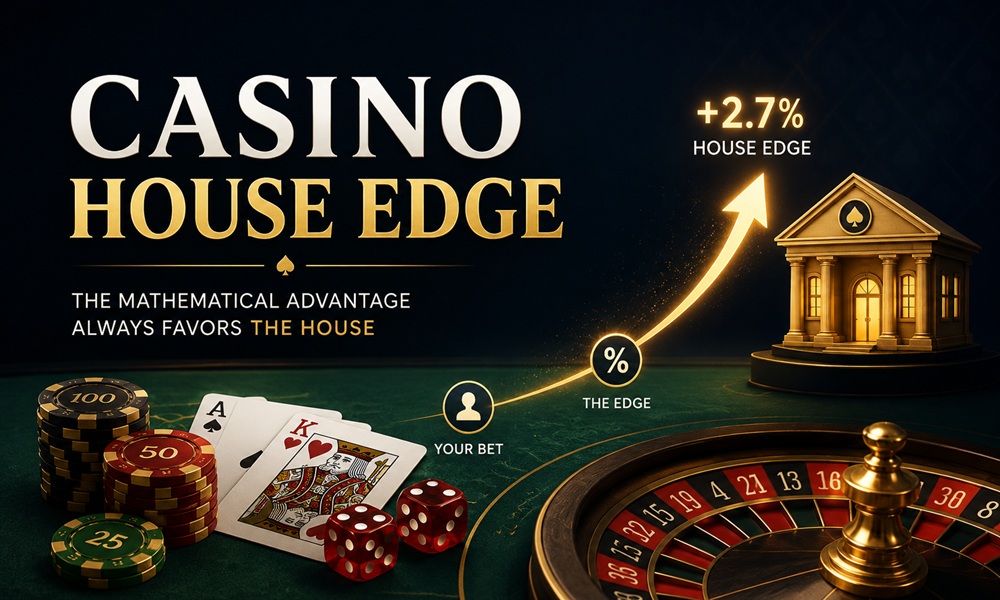
    The house edge is the casino’s built-in statistical advantage, expressed as a percentage of each bet it expects to keep over time. The number changes a lot from game to game. On one table you might be handing the house half a cent per dollar. On a nearby machine, you could be giving up a quarter of every dollar you wager.

    Knowing those numbers is the most useful thing a casual player can learn. It will not make you win, but it tells you which games stretch your money furthest. This guide lays out the house edge by game, explains the math in plain terms, and shows how to play the friendlier odds.

    What is the house edge, exactly?

    The house edge is the theoretical cost of playing a game over a long period. It represents the share of total wagers the casino keeps, with the rest returned to players as winnings.

    A simple way to see it: in a game with a 5% house edge, a player who wagers $1,000 over time can expect to lose about $50 on average. Short-term luck creates wins and bigger losses along the way, but over enough hands or spins, results converge toward that edge.

    One point trips up beginners. The house edge applies over the long run, meaning hundreds of thousands or millions of rounds. In a single session, anything can happen. That gap between short-term variance and long-term math is what keeps the games exciting and keeps the casino profitable.

    House edge by game: the full comparison

    Here is the number you came for. This table ranks common casino games from the lowest house edge (best for players) to the highest (worst). Figures assume standard rules, and where skill applies, optimal strategy.

    Game Typical house edge
    Blackjack (basic strategy, classic rules) ~0.5%
    Craps (odds bet behind pass line) 0% on the odds portion
    Baccarat (banker bet) 1.06%
    Video poker (full-pay, correct play) often under 1%
    Baccarat (player bet) 1.24%
    Craps (don’t pass) 1.36%
    Craps (pass line) 1.41%
    Texas Hold’em (casino version) ~2.19%
    European roulette (single zero) 2.7%
    Three Card Poker 3.4% to 7.2%
    Let It Ride ~3.5%
    American roulette (double zero) 5.26%
    Caribbean Stud Poker ~5.22%
    Slots 2% to 15% (often 5% or higher)
    Baccarat (tie bet) ~9% and up
    Big Six / Wheel of Fortune 11% to 24%
    Keno 25% to 35%

    A few takeaways jump out. The best odds sit at the tables, not the machines. And within many games, the specific bet matters enormously. Craps ranges from 0% on the odds bet to over 10% on center proposition bets. Baccarat runs from about 1% on banker to 9% or more on the tie.

    Why is blackjack the lowest house edge game?

    Blackjack leads the pack at roughly 0.5% with basic strategy and favorable rules. That means for every $100 wagered over time, the theoretical cost is about 50 cents.

    The reason is skill. In blackjack, your decisions change the outcome. Learning basic strategy (when to hit, stand, split, and double) keeps the edge at its lowest point. Play by instinct instead, and the edge climbs well above that figure. The same is true of video poker, where correct play on a full-pay machine can push the edge under 1%.

    Contrast that with roulette and slots, where the odds are fixed and no decision you make changes them.

    Why do slots and keno cost so much?

    At the other end sit the games of pure chance with steep math.

    Slots typically run a 2% to 15% house edge, often 5% or higher. Research into slot returns finds most titles land in an 85% to 97% return range. There is no skill factor. A random number generator decides every spin, and high volatility creates the illusion of hot and cold streaks. Progressive jackpot slots usually carry a higher edge, and if you are not chasing the jackpot, the base game return can drop sharply.

    Keno is the harshest common game, with a house edge often between 25% and 35%. Because outcomes come entirely from random draws, no strategy improves your results. For every dollar wagered, the expected return is far lower than table games or even slots.

    Big Six wheels (the tall vertical wheel of fortune) belong in the same worst-odds category, ranging from about 11% to 24% depending on the segment you bet.

    How does the house edge relate to RTP?

    They are two sides of one coin. RTP (return to player) is the average share of wagers a game returns to players over the long run. The house edge is what stays behind.

    The formula is simple:

    RTP + House edge = 100%

    So a slot advertised at 96% RTP carries a 4% house edge. A blackjack game with a 0.5% edge returns 99.5% RTP. When you see an RTP figure, you instantly know the house edge, and vice versa.

    This is worth checking before you play. For many online games you can look up the RTP, and if an exact number is not published, you can usually find a narrow range.

    Does any strategy beat the house edge?

    Short answer: no betting system beats it. But two things genuinely help.

    Game and bet selection. Choosing European roulette over American, banker over tie in baccarat, or blackjack over slots meaningfully lowers your expected loss. This is the biggest lever a casual player controls.

    Correct strategy in skill games. In blackjack and video poker, playing your hand correctly holds the edge at its lowest. A strategy chart is essential here.

    What does not work is changing your bet size to chase wins. The Martingale system (doubling after every loss) is a classic example. Neither dice nor a roulette ball has a memory. If nine blacks land in a row, the next spin is exactly as likely to be black as ever. Systems can help you manage a bankroll, but they cannot bend the underlying math.

    As players repeatedly point out on gambling forums, the phrases like “bet the tie after a tie” were almost certainly invented by the house.

    A smart player’s checklist

    To keep the odds as friendly as possible:

    • Head to the tables before the machines.
    • Learn basic strategy for blackjack, or a paytable for video poker.
    • Pick the low-edge bet within a game (banker in baccarat, pass line plus odds in craps, single-zero roulette).
    • Avoid the worst-odds games: keno, big wheels, and high tie or side bets.
    • Check the RTP on any slot before you spin.
    • Use flat betting to preserve your bankroll and play longer.

    Understanding the edge is not the same as beating it

    Here is the honest bottom line. The house edge guarantees the casino profits over time, on every game, no matter how you play. Understanding it does not remove it. What it does is let you choose games where your entertainment budget lasts longer and your odds are fairest.

    Treat gambling as paid entertainment, not a way to make money, because the math is not on your side over the long run. Set a budget, pick the low-edge games, and walk away when you hit your limit. If gambling ever stops feeling fun, take a break and reach out to a support service in your region.

    Frequently asked questions

    What casino game has the lowest house edge? Blackjack with basic strategy, at around 0.5%. Baccarat’s banker bet (1.06%), full-pay video poker (under 1%), and the craps pass line with odds are also excellent.

    What game has the worst odds? Keno, with a house edge often between 25% and 35%. Big-wheel games and high side bets are also among the worst.

    Is the house edge the same as RTP? They are opposites that add to 100%. A 96% RTP means a 4% house edge. Both describe the same long-term math from different angles.

    Can I beat the house edge with a betting system? No. Systems like Martingale cannot change a game’s fixed odds. Only game selection and correct strategy in skill games reduce your expected loss.

    Why is European roulette better than American? European roulette has a single zero and a 2.7% edge. American roulette adds a double zero, raising the edge to 5.26%. The extra pocket nearly doubles the cost.